Sharing Your Hearing Needs with Confidence
Simple strategies and ready-to-use phrases to help you explain your hearing loss clearly and confidently.
My hearing loss came as a shock. It was sudden, and within moments, I had lost all the hearing in my left ear. Dealing with the practical and emotional impact of my hearing loss happened in stages for me. First, I was focused on treatment options to help recover my hearing. When I had exhausted these, I explored hearing devices to help me make more sense of the world around me. I was also grieving for the sound I had lost and the life that I had thought I’d lead, where I didn't need to take my hearing into consideration. Well, not until much later in life, I thought. With time, I settled into life with single-sided deafness. I accepted my situation and decided I wanted to live my life the way I wanted to, bringing my hearing loss along with me.
In the beginning, I had no practical tools or understanding of how to talk about my hearing loss and how to ask for accommodations from the people closest to me, and from those I’d meet when out and about in the world. I had no time to prepare. I didn't know anyone else with hearing loss, and hadn't even considered how living day to day in a world without full sound would feel, or what challenges it might bring. If you’re living with hearing loss too, you may recognise these challenges and know how daunting it can feel to explain your needs to others.
Learning to Navigate Everyday Life
It soon became apparent to me that some situations were easier than others to hear people, to be able to join in with conversations confidently, and to hear enough of what someone has said to be able to offer a suitable response or ask appropriate follow-up questions. Quiet rooms with limited background noise were ideal for communicating, yet most places tend to have some level of noise, and I realised that even the hum of an aircon unit could hinder my ability to hear. Restaurants and cafes with the whirr of a coffee grinder, the clinking of cutlery, background music, chatter, and a lack of soft furnishings causing sound to bounce from wall to wall, were a different beast. Communication in these types of environments would no longer be easy, and I would need to work to feel included in conversations amidst background noise.
Adapting and Observing Conversations
I started watching people’s body language more, and the shapes their lips made held clues to what they were saying. I chose to sit in corners or with my back against a wall so that I would have some chance of being able to hear what the person, or people, sitting at my table were saying. I started to prefer one-on-one conversations, where I could give my conversation partner my whole attention, honing in on the unique sound of their voice, their phrasing, their mannerisms, and expressions. I became a better listener because of my hearing loss. But, there would always be times when I would need to speak up for myself and ask for accommodations from others to help support our communication.
Those closest to me learnt to walk on my hearing side and to speak clearly, but for people in the outer circles of my life, who hadn't worked through the challenges of hearing loss closely with me, they needed some explanation and guidance on how to support communication. I needed some tricks up my sleeve to be able to confidently tell people about my hearing loss in any situation, and how they could help make conversations smoother.
Talking About Your Hearing Loss
As a hearing loss coach, I often meet people who are looking for support with this same thing. They want to tell people about their hearing loss, but they’re not always sure how to say it confidently or how to ask for what they need.
It can be tricky to explain your needs when you meet someone for the first time, have a work conversation, sit in a noisy café, or go on a date. Explaining your hearing loss clearly and confidently is something you can learn. With practice, you can feel more in control in conversations, and communicating can become less tiring.
This guide offers practical tips and examples to help you handle these situations with confidence.
Building Confidence Before Asking for Accommodations
Before asking for accommodations such as quieter meeting spaces, captioning, or work adjustments, the first step is feeling comfortable talking about your hearing loss. It might feel unfamiliar at first and maybe a little scary. It can be helpful to practise short, clear descriptions to help you build confidence. Some of the ways I describe my hearing loss include the following:
In everyday conversations: “I’m deaf on this side” (pointing to my left ear), “I might not hear you sometimes, but I’ll let you know if I don’t.”
In more formal situations, such as when speaking to a receptionist at the hospital or at airport security: “I’m hard-of-hearing” or “I’m deaf,” often followed by, “please can you repeat that.”
You may have different ways from me of talking about your hearing loss. You do not need to label yourself to communicate effectively, and you might explain your hearing loss in different ways to different people in different contexts. Or you might have one way of speaking about your hearing loss.
Once you feel more comfortable speaking about your hearing loss, asking for support becomes much easier. Each small interaction where you confidently explain your hearing needs strengthens your ability to advocate for yourself.
Some people find it easier than others to talk about their hearing loss or to ask for what they need. Personality, past experiences, confidence levels, and how recently the hearing loss occurred can all play a role. Speaking up may feel natural to you, but it also might take time and practice.
Figuring Out What Helps
When my hearing loss first happened, I had no idea what I actually needed in conversations. I learned mostly through paying attention to everyday situations, noticing how the environment affected communication, where I was sitting, and how conversations were easier to follow when one person spoke at a time.
The following tips can help you figure out what might be helpful to you:
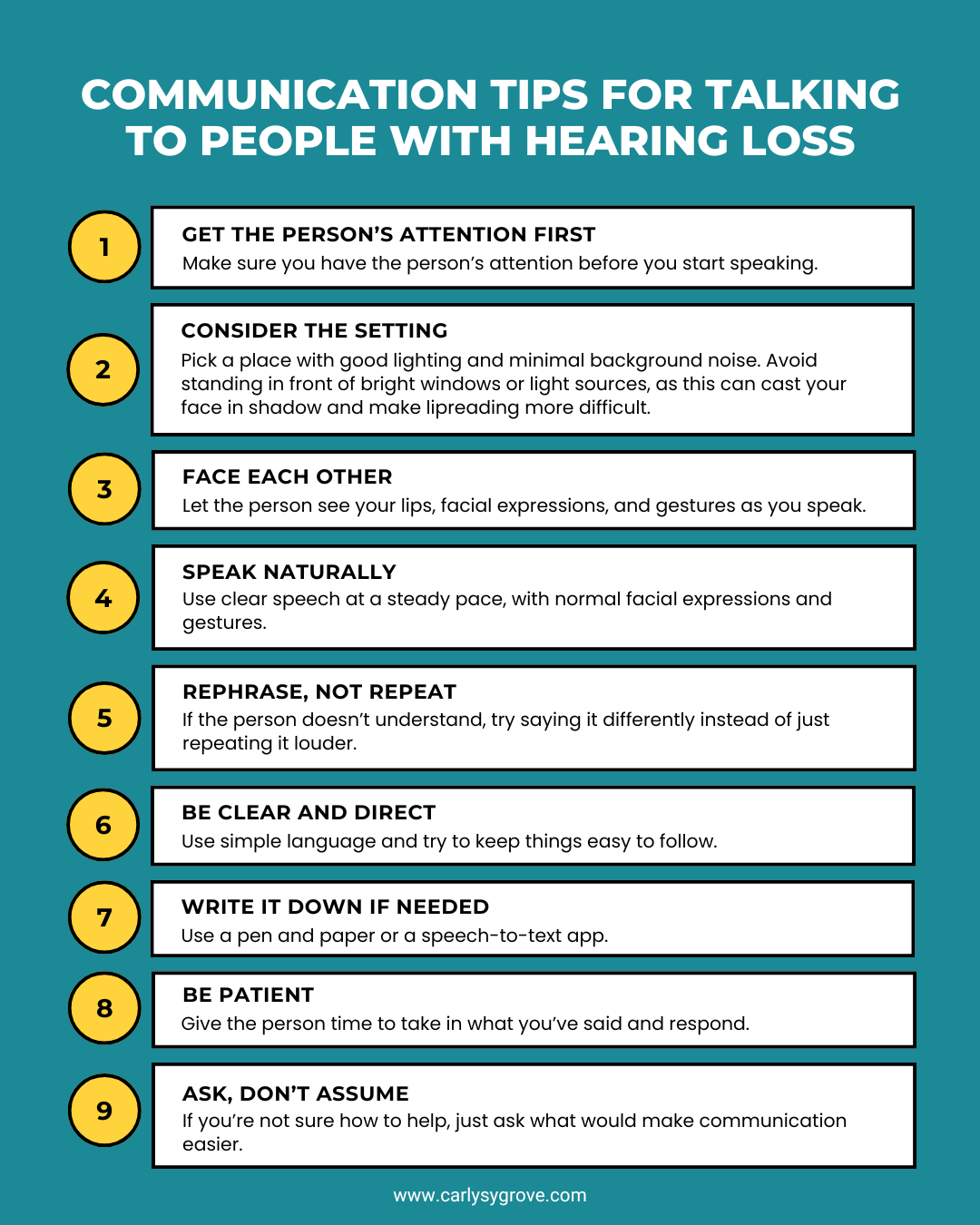

Even once I started to understand what helped, asking for it didn’t always feel easy. I worried about making a fuss, how much I needed to explain, and how other people might react, especially when meeting someone new or talking with people who hadn’t experienced my hearing challenges with me.
Coming Up With Short, Ready-to-Use Phrases
Once I recognised patterns in what helped me, I started creating a few short phrases I could use in most situations. Every person’s hearing loss is unique, and the way you communicate your needs can depend on the situation and who you are talking to.
In a first-time meeting, I found it best to keep it short and simple so the person understands my needs quickly. For example:
“I have hearing loss, so I might ask you to repeat things.”
“I hear best when people face me.”
For someone I interact with regularly, I could be more specific:
“I follow conversations better when one person speaks at a time.”
“Follow-up emails are great because they help me make sure I haven’t missed anything important.”
Keep it Short and Practical
You do not need to explain your full hearing story every time. Most people respond best to simple, solution-focused statements. Here is a simple formula you can follow:
State the hearing challenge → explain what helps
For example:
“I have some hearing loss, so I hear best when people face me.”
“Background noise makes it harder for me to follow, so quieter spots are best for conversation.”
“I sometimes miss words, so I may ask you to repeat things.”
This approach keeps explanations short, clear, and easy for others to respond to.
Over the years, I’ve used these phrases so often that I now keep them ready in my mind like a script. I don’t even have to think about how to explain my communication needs anymore.
Looking for Support?
If you'd like to explore support for everyday conversations or talking confidently about your hearing loss with loved ones, at work, or when out and about, please get in touch and tell me a little about your situation. We can discuss your challenges and explore whether coaching could be helpful for you.